

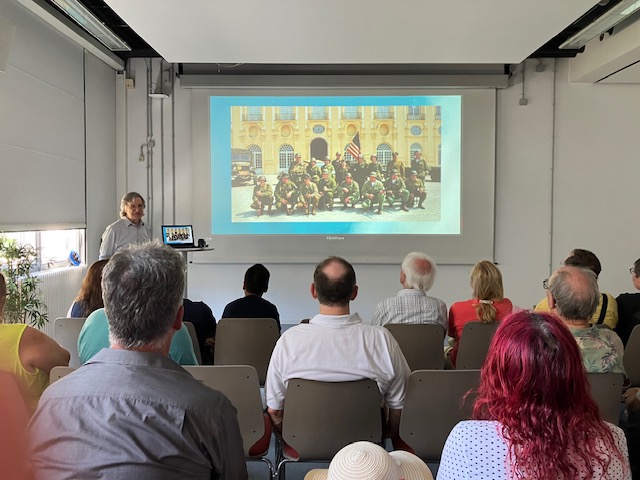
Günter Braun’s lecture on the end of World War II 80 years ago
The article “Die Amerikaner in Schleißheim” appears here at the suggestion of Günter Braun additionally in English for all Americans who also have memories of Oberschleissheim.
At the end of April 1945, the U.S. Army marched into Oberschleissheim and took over the town and the airfield without a fight. World War II was over.
Without a fight – that was by no means a given in our area. Hitler Youths set up an ambush in Lohhof, a roadblock was set up in Hochbrück, and SS men were entrenched in Neuherberg. The SS barracks at “Panzerwiese” on the outskirts of Munich had to be taken in a “room fight.”
Had there been further resistance in Oberschleissheim, there might have been another low-level attack on the town, which, as a military base, had already experienced eight air raids with severe destruction during the war.
This was prevented by the courageous commander of I./Nachtjagdgeschwader 6 and commander of the soldiers assigned to defense the airfield, Peter Spoden, who surrendered with his troops. Courageous, because by doing so, he exposed himself to the lynchings of Nazi fanatics, to which many more fell victims at the end of the war in Germany.
The Americans quickly repaired and reopened the airfield, not least because at that time they didn’t yet know exactly how much resistance there would be from the “Alpine Fortress” and the “Werewolf.”
The runway was extended from 800 to 1600 meters. The heavily damaged Junkers hangars were restored. They still look much the same today.
For this work, the U.S. Army became the largest employer in the greater Munich area at the time. As early as June 9, the first train of workers arrived from Munich. Food stamps were available, and all Germans were traveling with backpacks to “hoard” supplies, as the shortage was severe.
An “Industrial Police” was supposed to maintain order, and “Civilian Guards” guarded the military installations. But theft still occurred, especially cigarettes, the most important “currency” at the time.
The hangars were taken over by the American Joint Distribution Committee, the aid organization for DPs, “displaced persons”, and Jewish survivors of the Holocaust.
The barracks of the former aviation technical school south of the airfield were converted into a camp for former forced laborers, prisoners of war and concentration camp inmates. This camp was in operation until 1954. In the northern area of the airfield war scrap was collected, recycled, and sold.
Buildings in northern area of the airfield were also used for various youth activities initiated by the U.S. Army to re-socialize children in a new democratic way who had been influenced by National Socialism.
After the Hungarian Uprising in 1956, the airfield was fully operational again. Transport helicopters were stationed and helicopter pilots were trained for Vietnam. There were up to 64,000 flight movements per month.
For a time, Schleissheim was the American Army’s busiest airfield in Europe. This caused tremendous noise and sparked protests among the population. As a result, at least the flight routes were changed.
The fact that no satellite town with 30,000 residents was built on the site between Schleissheim and Munich also had something to do with the Americans in Schleissheim. This plan originated in Munich in the late 1950s and was intended to alleviate the acute housing shortage.
But the Americans didn’t want to abandon the airfield. The satellite town was then built in Neuperlach in the south of Munich.
There was also a housing shortage in Oberschleissheim after the war. Many families lived in temporary accommodations. In addition, the Americans had taken up residence with many locals.
After all, contrary to what is sometimes rumored, they paid decent rent relative to the average income. Günter Braun was able to demonstrate this with an impressive list of accounts.
In 1973, the U.S. Army handed over the airfield in Oberschleissheim to the Bundeswehr. The almost 30 years since the end of the war have certainly left their mark on the town. Not only because the “Amis” regularly caused traffic accidents and liked to get into fights when they got drunk – and because they apparently ran a brothel called “Club Deborah” here until 1965. But also because of the parties, the ice cream soda, and the hillbilly music in the NCO-Club, the former officers mess of the Luftwaffe.
And because of the childhood memories. The children of Schleissheim also saw people who didn’t have white skin for the first time in life. The children of Schleissheim also enjoyed the sweets the friendly GIs handed out.
Not to mention the chance to see a Mickey Mouse movie for the first time as part of the re-education program (e.g. the former mayor Elisabeth Ziegler). Or even to use the swimming pool at a time when having your own pool was unthinkable. Or for other adventures. The many listeners to Günter Braun’s lecture were certainly thrilled.
Andrea Wörle


0 Kommentare